
How to Teach Two-Digit Addition With Regrouping: a Free 2nd Grade Lesson
Want a free 2nd grade math lesson daily? Click here
If you are working out how to teach two digit addition with regrouping so that 28 + 19 stops coming back as 37, this is the lesson we use, and it is free.
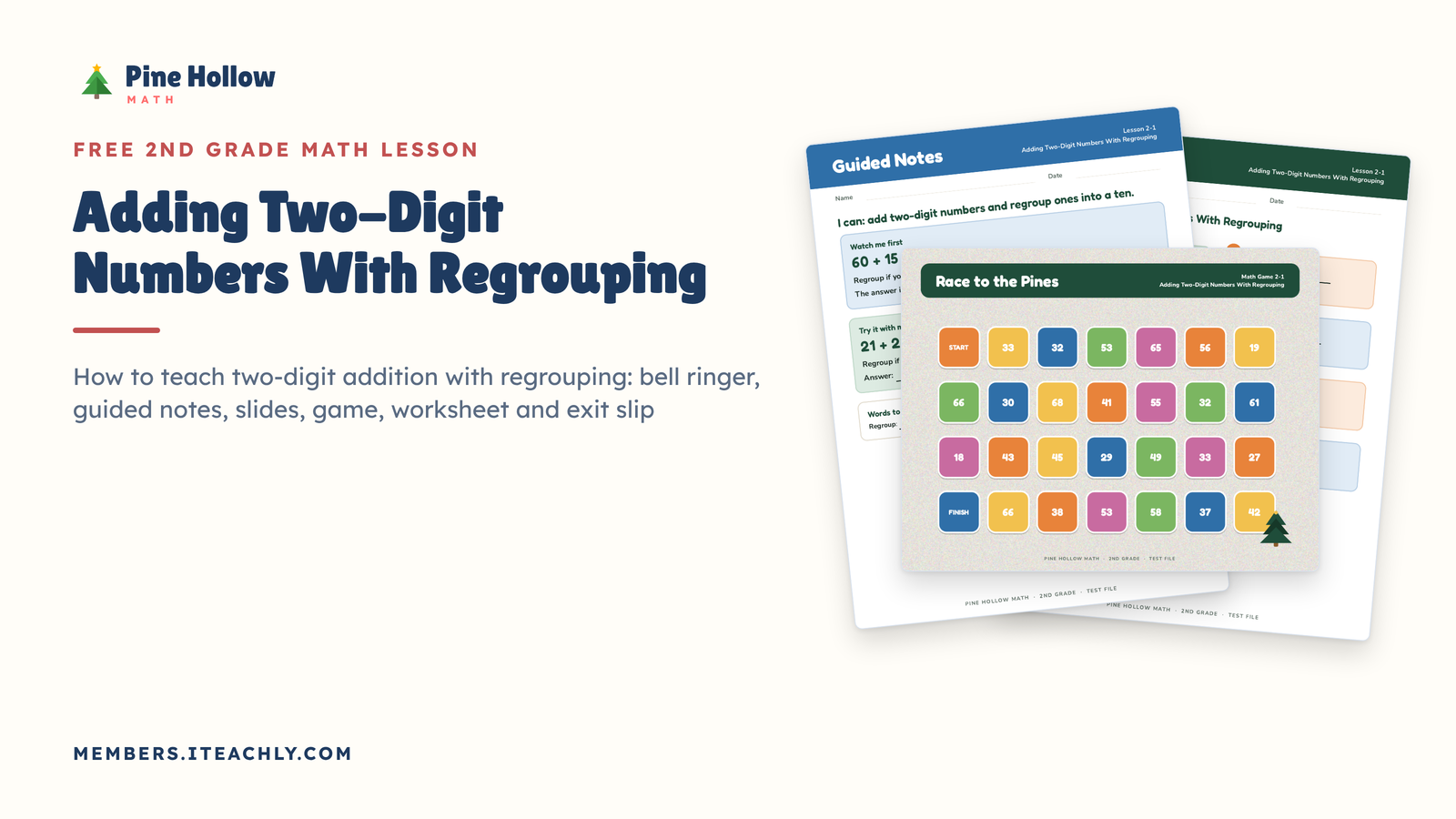
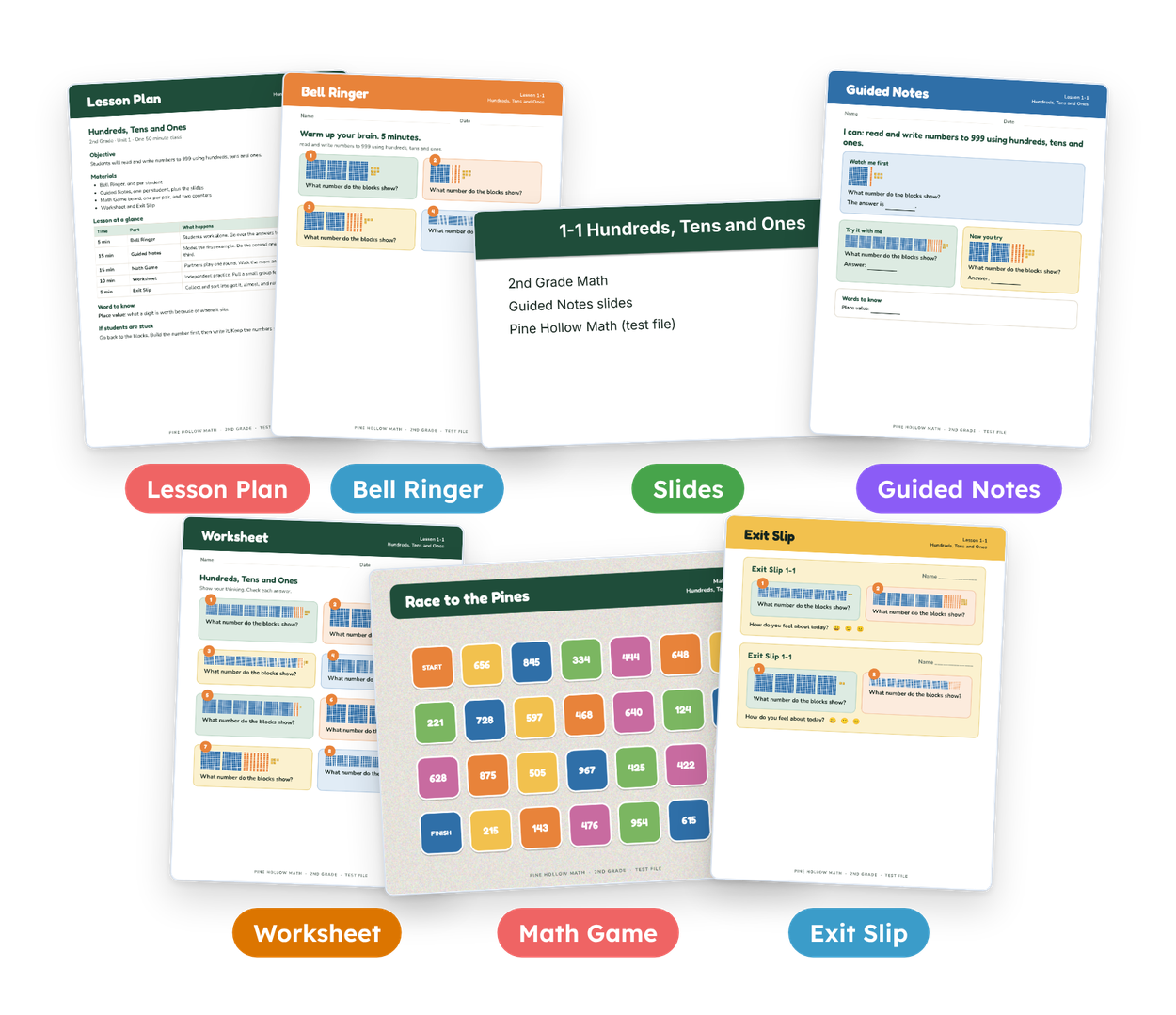
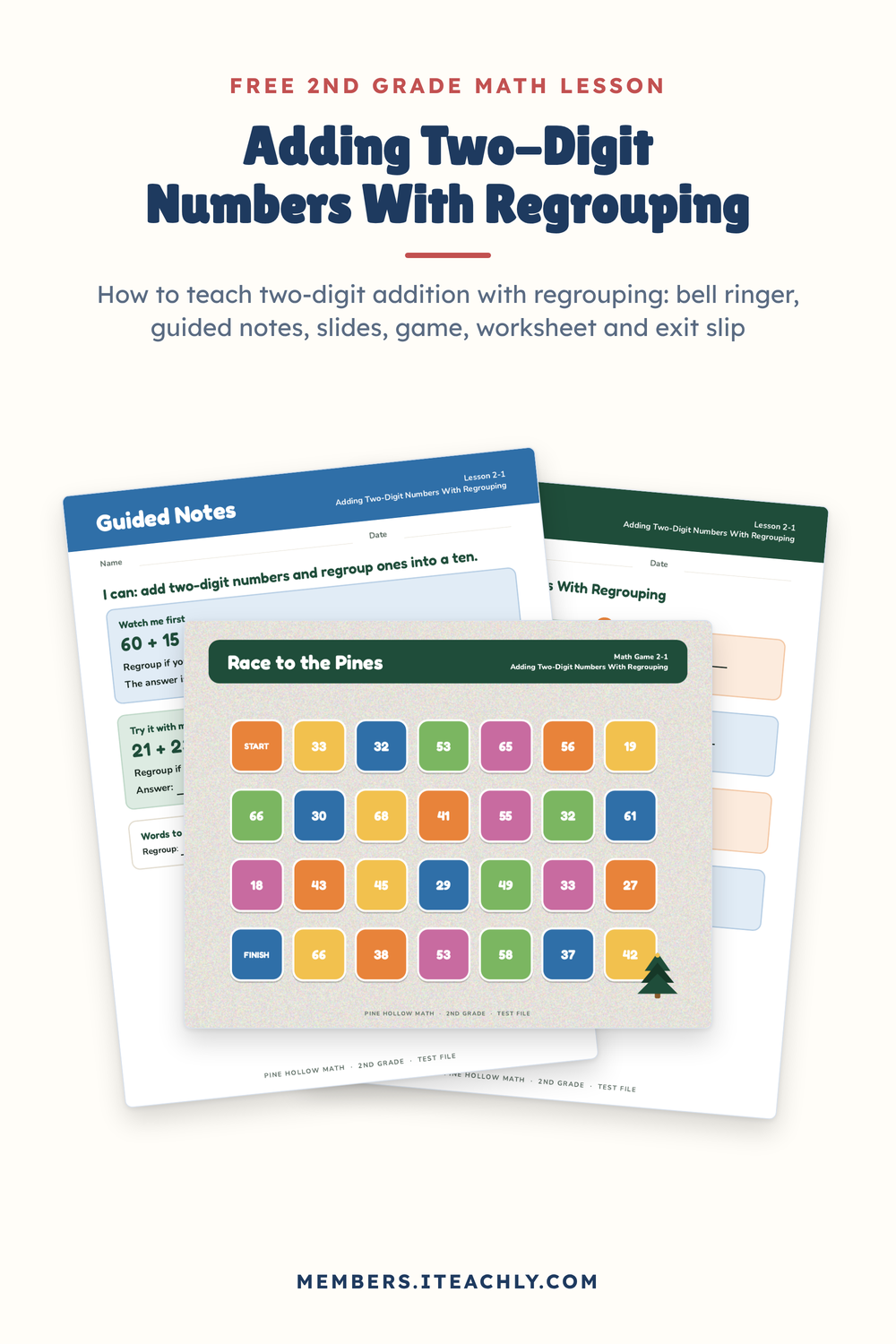
This is our two-digit addition with regrouping 2nd grade lesson, Lesson 2-1 of Unit 2, and the student files are below: the bell ringer, the guided notes, the slides, the game, the worksheet and the exit slip. Open the files, print the student pages, and teach it tomorrow. It fits one 50 minute class.
What regrouping is, in plain words
Add the ones first. When they make ten or more, trade ten of them for one ten and carry it to the tens place. That trade is regrouping, and it is the whole lesson: 28 + 19 is 17 ones, so one ten moves over and the answer is 47, not 37.
Every problem in this lesson says "Regroup if you need to", because the skill is deciding, not just carrying. Some of the problems regroup and some do not, so students have to look at the ones before they write anything.
The lesson at a glance
- Grade: 2nd grade
- Standard: Common Core 2.NBT.B.5: fluently add and subtract within 100 using strategies based on place value, properties of operations, and/or the relationship between addition and subtraction
- Standard: TEKS 2.4B: add up to four two-digit numbers and subtract two-digit numbers using mental strategies and algorithms based on knowledge of place value and properties of operations
- Time: one 50 minute class (5 bell ringer, 15 guided notes, 15 game, 10 worksheet, 5 exit slip)
- You need: the bell ringer, one per student, the guided notes, one per student, plus the slides, the game board, one per pair, and two counters, the worksheet and the exit slip
- Students will be able to: add two-digit numbers and regroup ones into a ten
Get the student pages (free, no email)
Vocabulary
- regroup: to trade 10 ones for 1 ten
- ones
- tens
Before you teach
Print the bell ringer, the guided notes, the worksheet and the exit slip, one each (the exit slip prints two to a page). Print one game board per pair and put two counters on each pair's desk. Have the slides open on the board.
- Students should already add two-digit numbers without regrouping and know what a ten is.
- Base-ten blocks on the desk help the students who need to see the trade. The plan sends stuck students back to the blocks.
The bell ringer: four problems, two of them regroup (5 minutes)
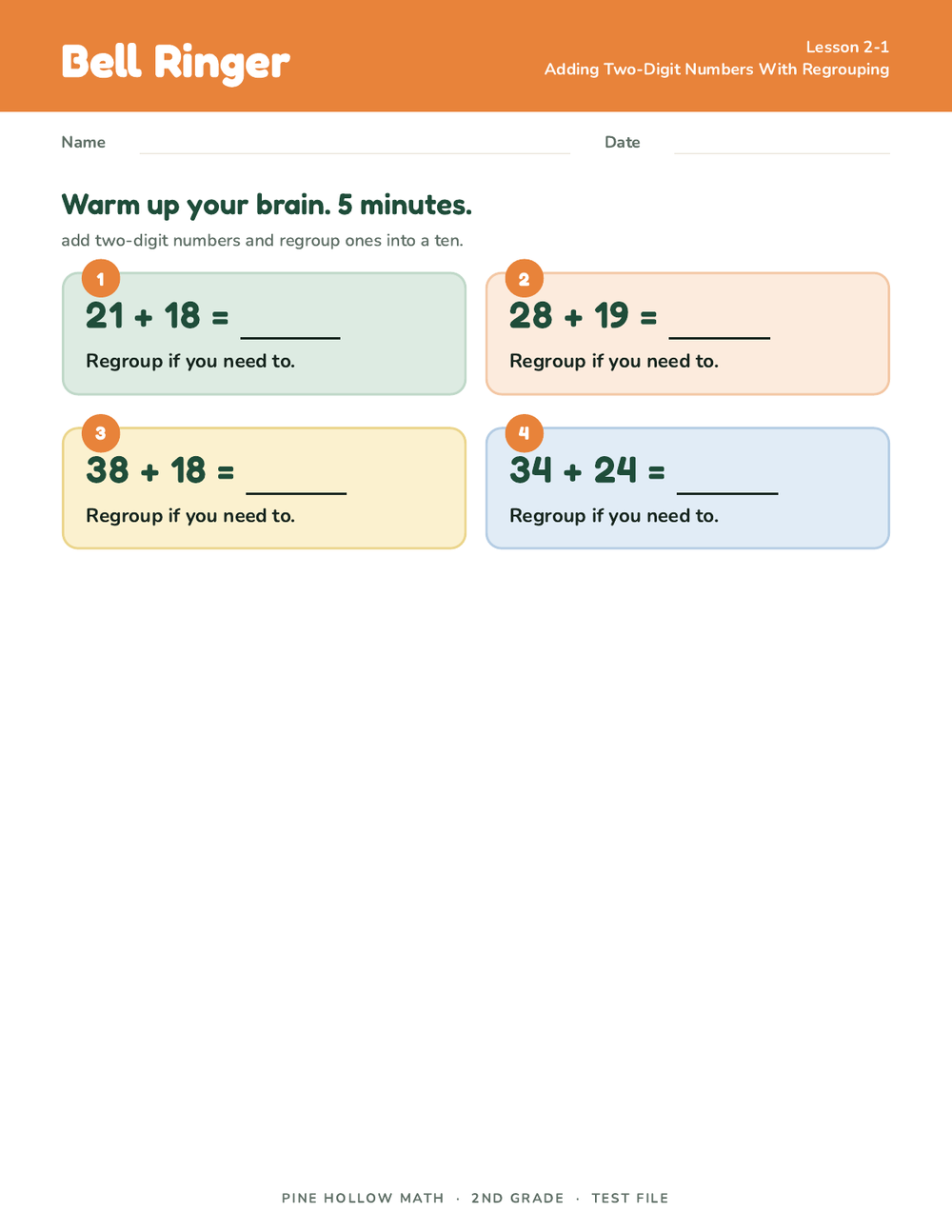
Four problems, alone, as students come in: 21 + 18, 28 + 19, 38 + 18 and 34 + 24. Two of them need a regroup and two do not, which shows you in five minutes who looks at the ones before writing and who regroups everything or nothing.
- Hand out the bell ringer as students come in.
- Give five minutes, alone.
- Go over the four answers together (39, 47, 56, 58) and ask which two needed a trade.
How to teach two-digit addition with regrouping: watch me first, try it with me, now you try (15 minutes)
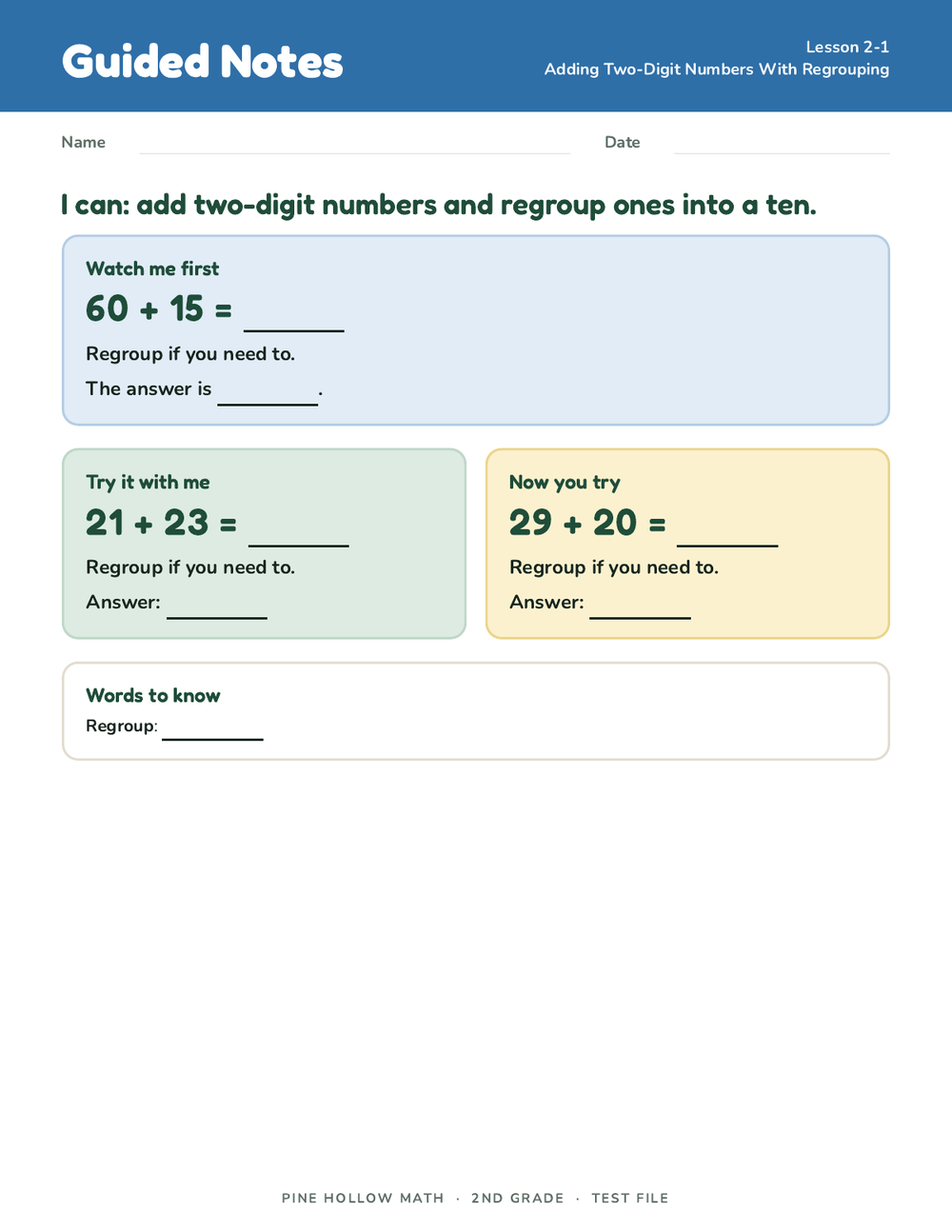
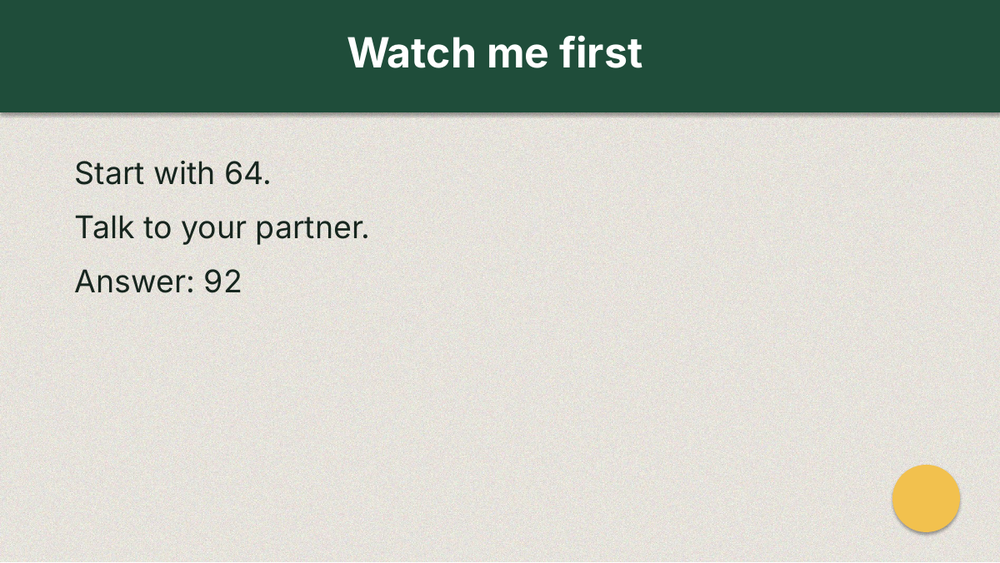
The guided notes and the slides run the same three-step pattern. You model the first example, the class does the second one with you, and students try the third on their own. Each slide says "Talk to your partner" before the answer shows, so every student says the trade out loud before they see it.
The notes page gives the I can statement at the top and a line for the word to know at the bottom, so the page ends with regroup written in the student's own hand.
- Model the first example on the slides: add the ones, trade ten of them for a ten, add the tens.
- Do the second example together on the notes.
- Students try the third one alone, then check it with a partner.
- Fill in the word to know: regroup, to trade 10 ones for 1 ten.
The slides, one step at a time
Six slides: the title, the I can statement, the word to know, and the three examples. Each example slide shows the starting number, tells students to talk to a partner, and then gives the answer.
The game: Race to the Pines (15 minutes)
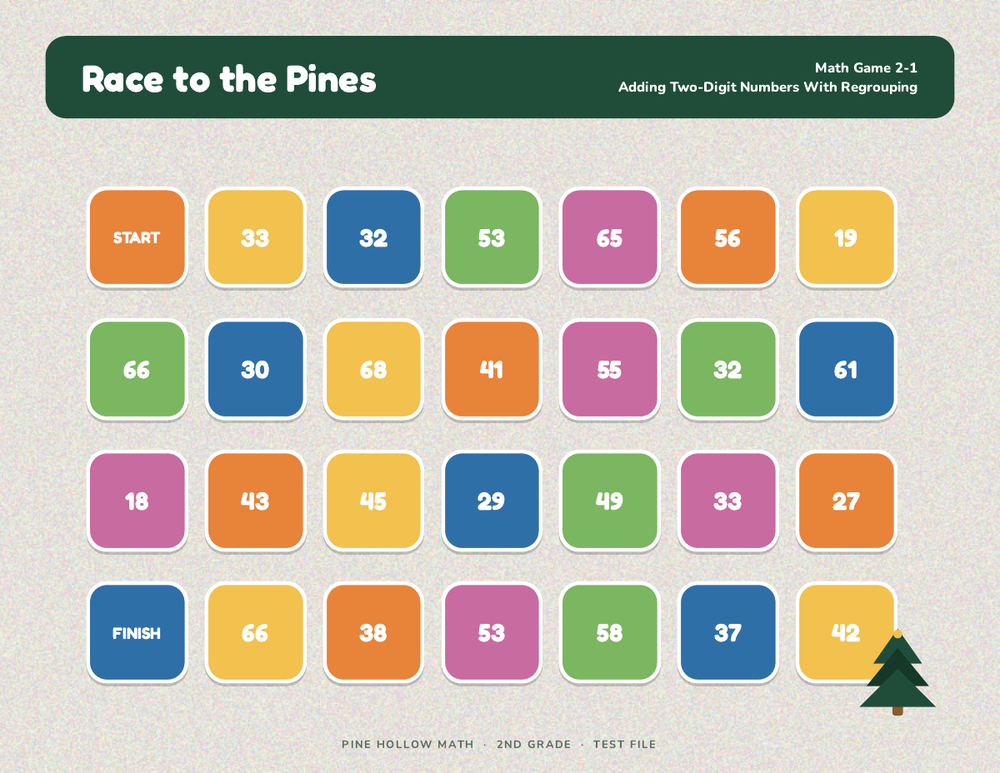
Partners share one board of 26 numbers from START to FINISH and a page of 12 question cards, every one of them a two-digit addition problem. Partner games are the two digit addition with regrouping games that get the math talk going, because a partner has to agree before anyone moves. Walk the room while they play: the game is where you hear who can explain the trade and who is guessing.
- Take turns. Flip a card and answer it.
- If your partner agrees, move ahead one space.
- First to the pines wins.
The worksheet and the exit slip (15 minutes)
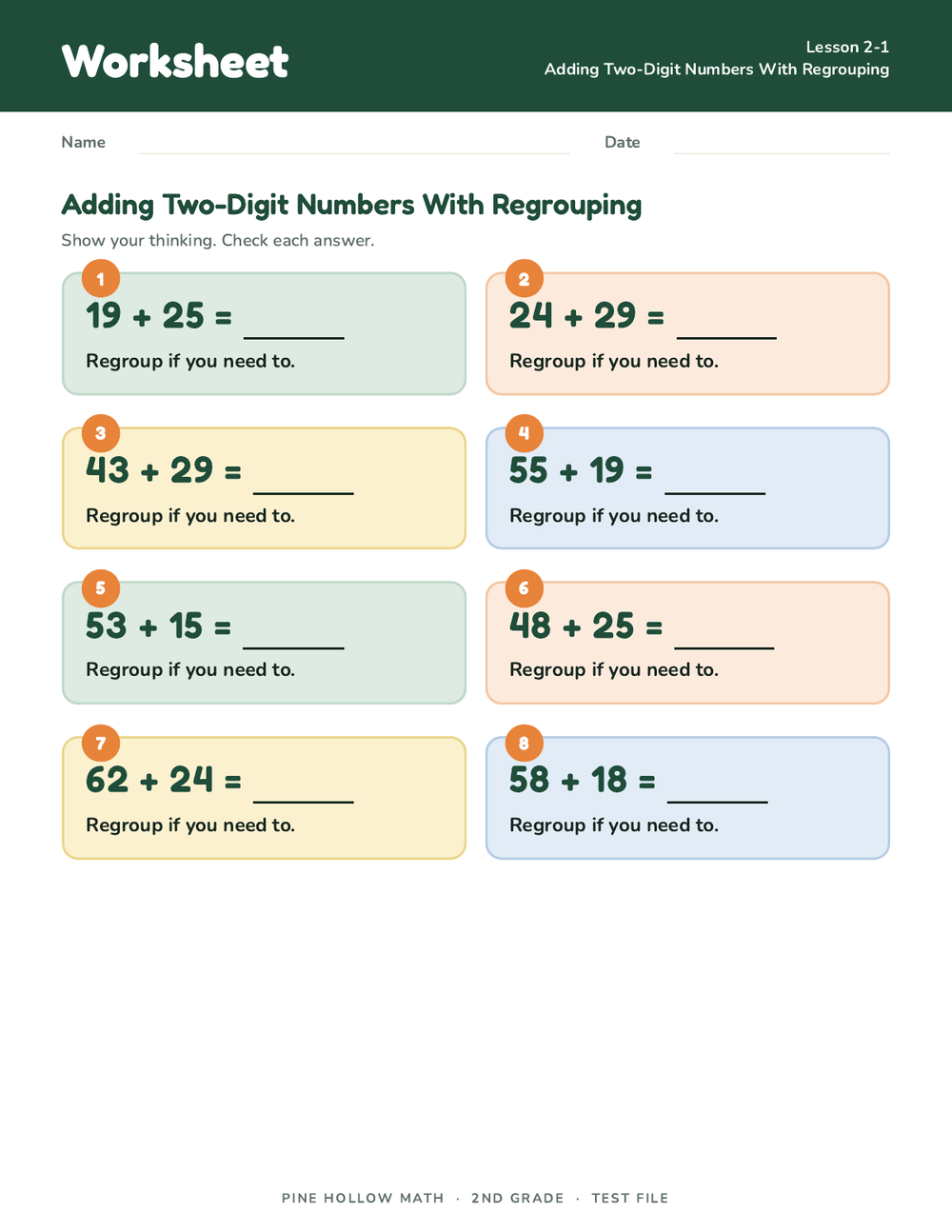
The worksheet has 14 problems over two pages for independent practice, so you can pull a small group for anyone who is stuck. If you came here looking for two digit addition with regrouping worksheets, this one is free below, with its answer key for members. The exit slip is two problems and a how-do-you-feel line, two slips to a page. Collect the slips and sort them into got it, almost and not yet; tomorrow's small group is the not-yet pile.
- Worksheet, 10 minutes, on their own. Show your thinking, check each answer.
- Exit slip, 5 minutes. Collect and sort.
Questions to ask your students
- In 28 + 19, how many ones do you have? What do you trade?
- Does 21 + 18 need a regroup? How can you tell before you add?
- Where does the ten you traded go? Show me on the blocks.
Where students get stuck
- Writing 17 under the ones in 28 + 19 instead of trading. Go back to the blocks: build the number first, then write it. Keep the numbers small until it clicks.
- Regrouping every problem, even 21 + 18. The bell ringer and the worksheet mix problems that regroup with problems that do not on purpose; ask students to say whether a trade is needed before they add.
Making it easier or harder
For students who need more support:
- Blocks on the desk for the worksheet and the exit slip.
- Keep the numbers small until the trade clicks, as the plan says.
For students who are ready for more:
- Students write their own card for the game: a problem that regroups and one that does not.
Here are the free files for this lesson
Click any file. They open on the downloads page. No email needed.
The Teacher Edition and answer keys are for members.
This lesson is from our Unit 2, Addition and Subtraction Within 100
- 2-1 Adding Two-Digit Numbers With Regrouping
- 2-2 Subtracting Two-Digit Numbers With Regrouping
See everything in the membership
More free 2nd grade math lessons
Questions teachers ask about regrouping
What is regrouping in math?
Trading 10 ones for 1 ten (or 1 ten for 10 ones, in subtraction). In 28 + 19 the ones make 17, so ten of them become a ten and move to the tens place. The lesson's word to know says it in one line: regroup, to trade 10 ones for 1 ten.
How do you teach addition with regrouping?
Ones first, then the trade, then the tens, and say the trade out loud before writing it. This lesson does it as watch me first, try it with me, now you try on the guided notes and the slides, then a partner game, then a worksheet and an exit slip.
How do you teach regrouping with base ten blocks?
Build both numbers, push the ones together, and when there are ten or more, trade ten of them for a rod. The plan's advice for a stuck student is the same: go back to the blocks, build the number first, then write it, and keep the numbers small until it clicks.
Is there a free two digit addition with regrouping worksheet PDF?
Yes. The worksheet (14 problems over two pages) is on the downloads page above, with the bell ringer, the guided notes, the slides, the game and the exit slip. No email needed.
What is the Common Core standard for adding with regrouping in 2nd grade?
2.NBT.B.5: fluently add and subtract within 100 using strategies based on place value, properties of operations, and/or the relationship between addition and subtraction. In Texas the lesson lines up with TEKS 2.4B.
Want every 2nd grade math lesson right now?
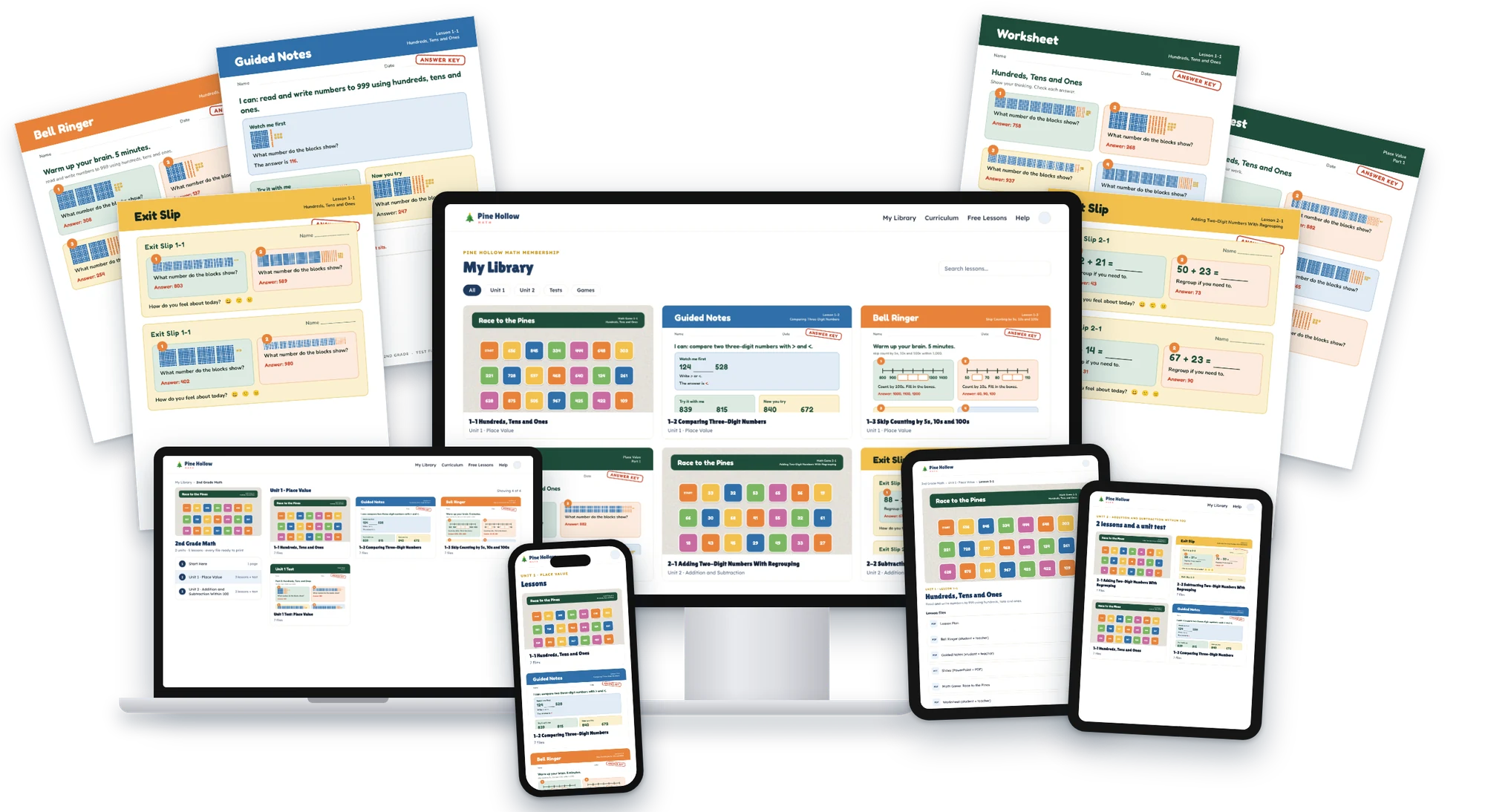
The membership has every unit, every file, and new lessons as they are added. Open the lesson you need tomorrow, print it, teach it.
Get free 2nd grade math lessons daily
A full lesson in your inbox every day, from the same membership this one came from.
Pin this for later
Want every 2nd grade math lesson, ready to teach?
The membership has every unit, every file, and new lessons as they come. Open the lesson you need tomorrow, print it, teach it.
Get free 2nd grade math lessons daily
A full lesson in your inbox every day. No credit card, nothing to cancel.
We are teachers. Your email is safe with us.